The single most common mistake in group airport transportation is not a scheduling problem — it is a vehicle-sizing problem. A group of five with carry-ons and checked bags does not fit comfortably in a sedan built for three, and a group of ten split awkwardly across two mismatched cars arriving at different times creates exactly the kind of confusion group travel is supposed to avoid.
This guide breaks down what a sedan, SUV, and Sprinter van actually hold in real-world conditions — not the theoretical seatbelt count, but the number that works once bags, golf clubs, car seats, or event attire are factored in — so your next group booking out of Dulles gets the right vehicle on the first try.
Getting this right matters more at Dulles specifically than at a smaller regional airport, because the terminal's mid-field concourses and AeroTrain transfers mean a mis-sized vehicle discovered at curbside cannot simply be swapped for a bigger one on the spot — the group is stuck waiting for a second car to be dispatched while everyone else in the booking stands around with luggage. Planning the right vehicle before you fly avoids that entirely.
Sedans: Best for One to Three Travelers
A business sedan like the Mercedes-Benz E-Class comfortably seats three adults with two to three standard suitcases in the trunk. It is the right call for a solo executive, a couple, or a small family of three traveling light — and it is the most cost-efficient option per trip when a larger vehicle would simply be underused.
Where sedans fall short is the detail travelers forget until they are standing at curbside with more bags than seats: a fourth passenger, a stroller, or a fourth piece of luggage pushes a sedan past its real capacity even though it technically has a back seat for three. If your group is right at that line, size up rather than hope it fits.
A first-class sedan — a BMW 7 Series or Mercedes S-Class — offers the same three-passenger practicality with more presence and legroom, a common upgrade for a client pickup or an anniversary trip where the vehicle itself is part of the experience rather than just transportation from point A to point B.
A sedan is also the right call for a traveler who specifically wants a quiet cabin to work in on the drive — a conference call, a last read-through of meeting notes, or simply catching up on email before landing at a client site. The smaller cabin of a sedan, compared to an SUV or van, generally makes for a quieter ride with less road noise, which matters for anyone planning to be on the phone for a meaningful part of the trip.
Couples traveling together without children, or two business colleagues sharing a ride to the same meeting, are the other common sedan booking that gets overlooked in sizing conversations focused mainly on families and larger groups. A sedan handles this pairing comfortably with room to spare, and booking a larger vehicle for two travelers with normal luggage is simply an unnecessary cost that does not improve the experience in any meaningful way.
SUVs: The Workhorse for Four to Six Travelers
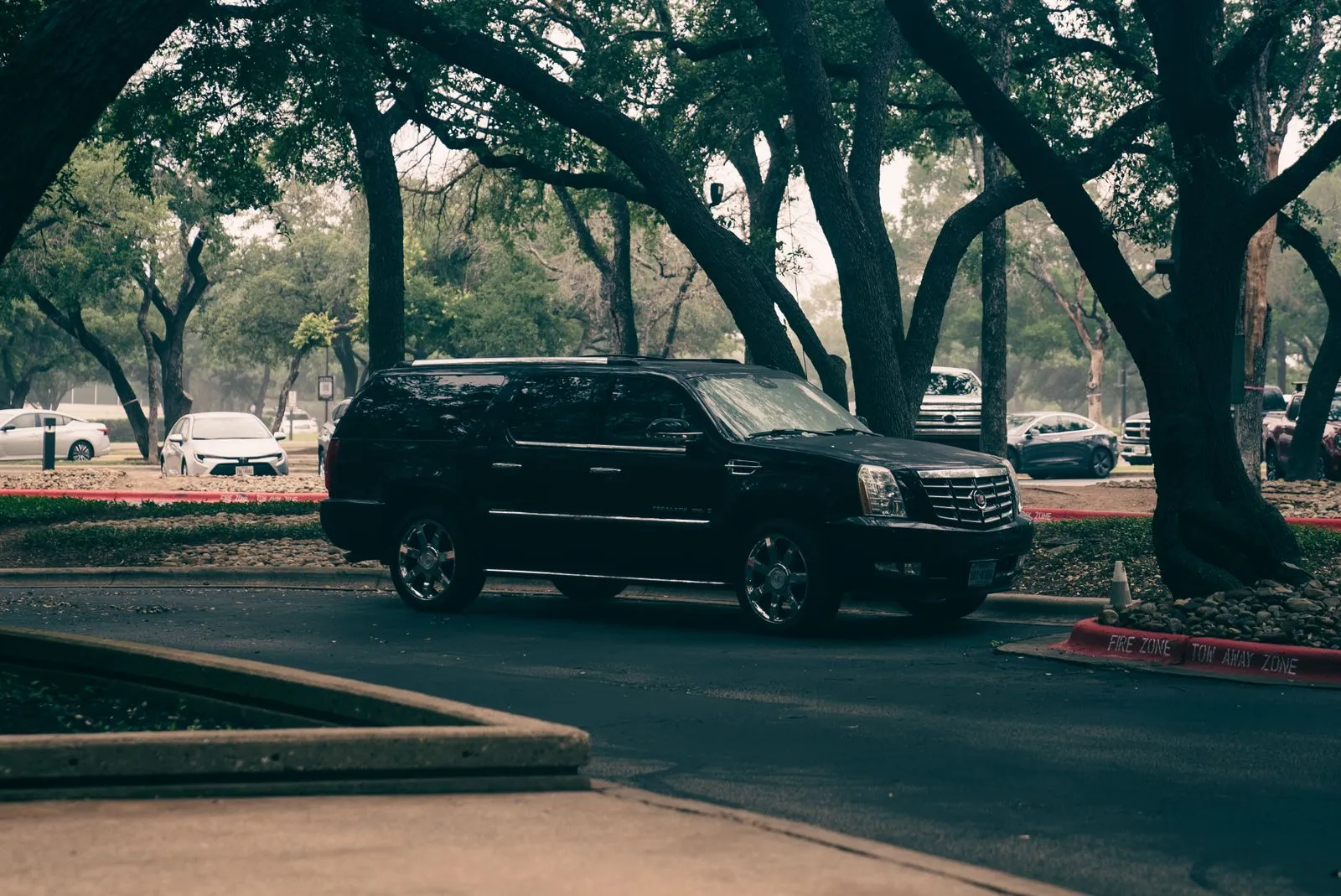
A midsize SUV like the Lincoln Nautilus handles four passengers with luggage comfortably, and a premium SUV like the Cadillac Escalade or a Chevrolet Suburban stretches that to five or six passengers with full-size luggage — the most frequently booked configuration for Dulles-area families and small business groups.
The Escalade specifically earns its popularity for group airport runs: six real seats, a cargo area that handles checked bags without stacking luggage on laps, and enough road presence that a group arriving for a conference or event doesn't feel like an afterthought. For a group of five to six with normal luggage, this is almost always the right call before jumping straight to a van.
Families traveling with young children should note that an SUV's third row, where present, is usually sized for smaller adults or children rather than full-size adult passengers with their own luggage — if your group of six includes several large adults with full suitcases, it is worth confirming exact cargo and seating dimensions with your reservation specialist rather than assuming every six-passenger SUV fits your group the same way.
A premium SUV also tends to be the preferred choice for a small corporate group that wants a vehicle with real presence for a client pickup or an executive arrival, without the formality of a stretch limousine or the scale of a full Sprinter van. The Escalade in particular has become something of a default recommendation for exactly this middle-ground use case across the industry.
One detail worth checking rather than assuming: not every "SUV" in a fleet listing has identical third-row legroom or cargo volume, and model years and trim levels vary meaningfully between companies and even within the same company's fleet over time. If your group is right at the edge of SUV capacity, ask your reservation specialist for the specific model that will be assigned rather than relying on the general vehicle class name alone.
Sprinter Vans: When Your Group Passes Six
Once a group exceeds six travelers, or six travelers with an unusual amount of luggage — golf bags, musical instruments, trade-show material — a Mercedes Sprinter is the only vehicle that keeps everyone and everything together in one trip. Sprinter configurations vary by trim: a Shuttle-style layout maximizes seat count for up to 13 passengers, while an Executive configuration trades some seats for more legroom and worktable space, useful for a group that wants to prep for a meeting en route.
The practical advantage of a single Sprinter over two SUVs is coordination, not just capacity: one vehicle means one pickup time, one chauffeur, and no risk of the group splitting up and arriving at different times at a venue or hotel. For corporate groups and wedding parties alike, this is usually worth it even when the headcount technically fits in two smaller vehicles.
The Sprinter Executive trim adds stretch-limousine styling on top of the van's capacity, which some groups prefer for an event-day booking — a wedding party or milestone celebration — where the vehicle itself is part of the occasion rather than purely functional transportation.
For groups that specifically want to work or socialize during the ride rather than simply sit in rows, the Sprinter Executive configuration's forward-facing seating and worktable layout is worth requesting by name when booking, since the default assignment for a given passenger count may otherwise be the higher-capacity Shuttle layout instead.
A Sprinter also handles mixed-age groups better than most people expect — a party that includes small children, grandparents, and able-bodied adults all traveling together benefits from the step height, aisle space, and overall room to move around that a van provides compared to climbing into and out of a lower SUV repeatedly across several stops in a single day.
Luggage, Car Seats, and the Details That Change the Math
Passenger count is only half the sizing question. A family traveling with car seats needs to confirm in advance whether the vehicle accommodates them properly installed alongside full luggage — car seats take up real space that a headcount-only estimate misses. Golf clubs, skis, and oversized trade-show cases behave the same way: they count against capacity even though they are not passengers.
When in doubt, describe your actual group to a reservation specialist — headcount, luggage type, and any special equipment — rather than guessing a vehicle class from a seating chart alone. A five-minute conversation before booking avoids a curbside surprise that no chauffeur can solve on the spot.
A useful habit: count your bags the same way an airline would — one carry-on and one checked bag per person as a baseline, then add anything beyond that explicitly. A group that assumes "normal luggage" but is actually traveling with extra equipment is the single most common reason a booked vehicle turns out too small on arrival day.
Oversized sporting equipment deserves its own specific mention rather than being lumped in under a general "extra luggage" note, because a single golf bag or a pair of ski bags can occupy roughly the same cargo space as an additional full-size suitcase, and two or three sets of either can functionally use up an entire trunk on their own before a single passenger's personal bag is even loaded. A reservation specialist who hears "two golf bags" rather than simply "some extra stuff" can make a far more accurate vehicle recommendation, and a traveler who mentions this detail up front virtually never ends up disappointed with the vehicle that shows up at the curb.
Booking Multiple Vehicles for Larger Groups
For groups larger than a single Sprinter can hold — a wedding party with a hotel block, a corporate retreat, a school or sports team — multiple vehicles can be coordinated against one shared pickup schedule through a single dispatcher, so vehicles arrive and depart together rather than independently. This is the same coordination used for conference shuttles and wedding guest transportation, and it scales to almost any group size with enough advance notice.
The rule of thumb across every group size: book the vehicle for the group you actually have, including luggage and equipment, not the group you expect to have. It is the single easiest way to avoid a last-minute scramble at IAD's arrivals curb.
If your group's exact size is still uncertain when you need to book, reserve for the larger end of your estimate — upsizing a vehicle class before the trip is a simple adjustment, while discovering a shortfall on the day itself is not.
Two Group Bookings That Almost Always Need a Sprinter
Prom groups are a frequent example of exactly this sizing problem in practice: ten to fourteen students in formalwear, plus any shared accessories, almost always calls for a Sprinter van rather than splitting into two SUVs that risk arriving at the venue at different times — our city-specific prom limo pages cover how that group pricing and scheduling typically works.
Wedding guest shuttles between a hotel block and a rural estate venue are the other common case, where a single Sprinter running a fixed loop handles far more guests per trip than individual sedans and avoids the parking problem many Loudoun and Fauquier venues create for a line of guest cars.
Related Pages
Frequently Asked Questions
How many passengers fit in a Cadillac Escalade with luggage?
A Cadillac Escalade comfortably seats five to six passengers with full-size luggage, making it the most popular choice for groups that outgrow a sedan but do not need a full Sprinter van.
When should I book a Sprinter van instead of an SUV?
Once your group passes six travelers, or six travelers with an unusual amount of luggage like golf bags or trade-show material, a Sprinter van is the only option that keeps everyone in one vehicle for the full trip.
Do car seats count against vehicle capacity?
Yes. A properly installed car seat takes up real passenger space alongside luggage, so families traveling with car seats should mention them when booking rather than relying on headcount alone.
Can I book multiple vehicles for a large group arriving at different times?
Yes. Multiple vehicles can be coordinated against one shared schedule through a single dispatcher, which keeps a wedding party, conference group, or sports team arriving together rather than independently.
Is it cheaper to book two SUVs instead of one Sprinter van?
Not usually once luggage and coordination are factored in. A single Sprinter typically costs less than two SUVs and avoids the risk of a group arriving split across two different pickup times.