
Wedding transportation is one of the few vendor decisions on a wedding day that has no second chance — if the car is late, or too small for the wedding party, or the driver does not know the venue, there is no reshoot. This guide covers what actually matters when booking wedding limo service anywhere across Washington DC, Maryland and Virginia: how pricing works, which vehicle fits your group, the real venues we serve most often, how to build the timeline with your planner, and — most importantly — the specific questions worth asking any transportation company before you put down a deposit, wedding-specific or not.
Most of what is published online about wedding limos is either a bare list of vehicle photos or vague language about "making your day special" with no real information underneath it. This guide is the opposite: specific vehicle capacities, specific pricing logic, specific venues, and specific answers, because that is what actually reduces stress on the one day where there is no room for a surprise.
How Wedding Limo Pricing Actually Works
Wedding transportation is quoted differently from a simple airport transfer, because a wedding almost never involves a single point-to-point trip. Most weddings need the vehicle to be available across a window of several hours — getting-ready location to ceremony, ceremony to photos, photos to reception, and sometimes a late-night exit — which is why wedding bookings are priced hourly with a minimum, rather than as one flat point-to-point fare.
The rate is confirmed in writing before you book: vehicle class, hours reserved, and total price, with no surge pricing added regardless of how popular your wedding date is with other couples that weekend. Overtime, if your reception runs long, is billed at the same confirmed hourly rate rather than a punitive after-the-fact charge — but tell your chauffeur coordinator your realistic end time up front so the reservation is sized correctly from the start.
Deposits are standard in this industry and ours is no exception, but a deposit should always come with a written confirmation of vehicle, hours and rate attached to it — never a verbal promise. Cancellation policy for wedding and special-event bookings (Sprinter vans, limousines, and similar vehicles reserved for an event) allows free cancellation up to 12 hours before pickup, longer than the 3-hour window on a standard sedan or SUV transfer, because event-day vehicles are held specifically for you rather than kept in general rotation.
Which Vehicle Actually Fits Your Wedding Party
The most common sizing mistake is booking a vehicle for the couple alone and forgetting the wedding party needs its own transportation too. A Mercedes-Benz E-Class or BMW 7 Series sedan is right for the couple's own exit — quiet, private, and appropriately elegant for the getaway — but a wedding party of four to six bridesmaids or groomsmen needs a Cadillac Escalade or Chevrolet Suburban, and a full party of eight or more is a Sprinter Shuttle or Sprinter Executive van.
For a wedding party larger than 13, or for guest shuttle service between a hotel block and a venue with limited parking, we coordinate multiple vehicles that arrive and depart together on the same schedule, rather than a mismatched fleet showing up at different times. The Sprinter Limo — a stretch-configured Sprinter — is worth considering specifically when you want limousine styling with more capacity than a traditional stretch sedan provides.
A detail couples often miss: if the ceremony and reception are at different venues, the getting-ready location often needs its own separate vehicle running simultaneously with the ceremony-to-reception vehicle, so the wedding party is not waiting on a single car to make two round trips. Walk through your actual day, location by location, before deciding how many vehicles you need — not just how many you would like to have.
Real Venues We Serve Across the Region
Ladew Topiary Gardens in Baltimore County is one of the region's most photographed wedding settings, and its rural setting means a chauffeur who already knows the approach roads and the venue's staging area saves real time versus a driver navigating it for the first time. We typically stage a Sprinter van or stretch limousine there for wedding parties.
Potomac and Bethesda estate venues along the American Legion Bridge corridor are a frequent booking for DC-area couples, along with the country club circuit in that same stretch of Montgomery County. Frederick County draws couples toward its barns and vineyards along I-270 and Route 15, including Ceresville Mansion — a longer drive from DC that benefits from a chauffeur who plans around Route 15 traffic patterns rather than a straight GPS estimate.
On the Eastern Shore, Chesapeake Bay Beach Club is a common Bay Bridge wedding destination; the two-hour-plus drive from Northern Virginia in summer traffic is exactly the kind of trip where a flat, confirmed rate beats an unpredictable rideshare fare that climbs with distance and demand. In Loudoun County, the wine-country venues along the Route 15 and Route 50 corridors host a steady run of vineyard weddings, where gravel drives and limited turnaround space call for a chauffeur experienced with those specific properties. And inside DC itself, hotel ballroom weddings remain common, where curbside coordination with hotel staff and valet is its own small skill a chauffeur builds only by doing it repeatedly.
Building the Timeline With Your Planner or Venue
Share your draft timeline the moment you book, even if it is not finalized — getting-ready address, ceremony time, photo locations, and reception venue. We flag unrealistic timing before the wedding day, not on it: a fifteen-minute buffer that looks fine on paper is often not enough once you account for a bridal-party photo stop or Beltway traffic between venues.
If you are working with a day-of coordinator, put them in direct contact with your chauffeur coordinator ahead of time rather than routing every update through the couple on the day itself. Coordinators who plan weddings regularly already know to build in buffer time around vendor transitions, and a transportation team that talks directly to them catches scheduling conflicts earlier.
Every wedding booking includes a dry run of the primary route before the day itself, so the chauffeur already knows the ceremony venue's specific drop-off point, the reception's loading area, and any detail — a gravel drive, a low awning, a strict venue-imposed arrival window — that would otherwise be a surprise on the day.
What to Ask Any Wedding Transportation Company Before You Book
Ask directly whether the company is a licensed and insured commercial carrier, not simply "insured" in a vague sense — a personal auto policy is not the same as commercial liability coverage, and the difference matters if anything goes wrong on your wedding day. Ask whether your specific chauffeur will be confirmed by name ahead of time, or whether you are booking a vehicle from a general pool with whoever is available assigned the morning of.
Ask what happens if your ceremony or reception runs long — is overtime billed at the same confirmed hourly rate, or does the company reserve the right to charge more once you are already mid-event? Ask whether the company has actually driven to your specific venue before, particularly for rural properties like vineyards and estate grounds where a wrong turn costs real time.
Ask what the cancellation and rescheduling policy is in writing, not verbally, and get the vehicle, hours and total rate confirmed in an email or contract before any deposit changes hands. A company confident in its own service has straightforward answers to all of this; vague answers to any of these questions are worth treating as a real signal, not a formality to skip past.
Bridal Party Logistics and Extras
Complimentary touches worth confirming in advance: red carpet arrival, "Just Married" signage for the departure vehicle, and bottled water for the wedding party during a long stretch between the ceremony and reception. Ask specifically whether these are included in your quoted rate or billed as add-ons, since practices vary by company and it is better to know before the day rather than see it itemized afterward.
For the wedding party specifically, book based on headcount plus garment bags and any group luggage if travel is involved — a Cadillac Escalade seating six comfortably seats fewer than six once evening gowns and suit bags are accounted for. When in doubt, size up one vehicle class rather than risk a cramped ride to photos in formalwear.
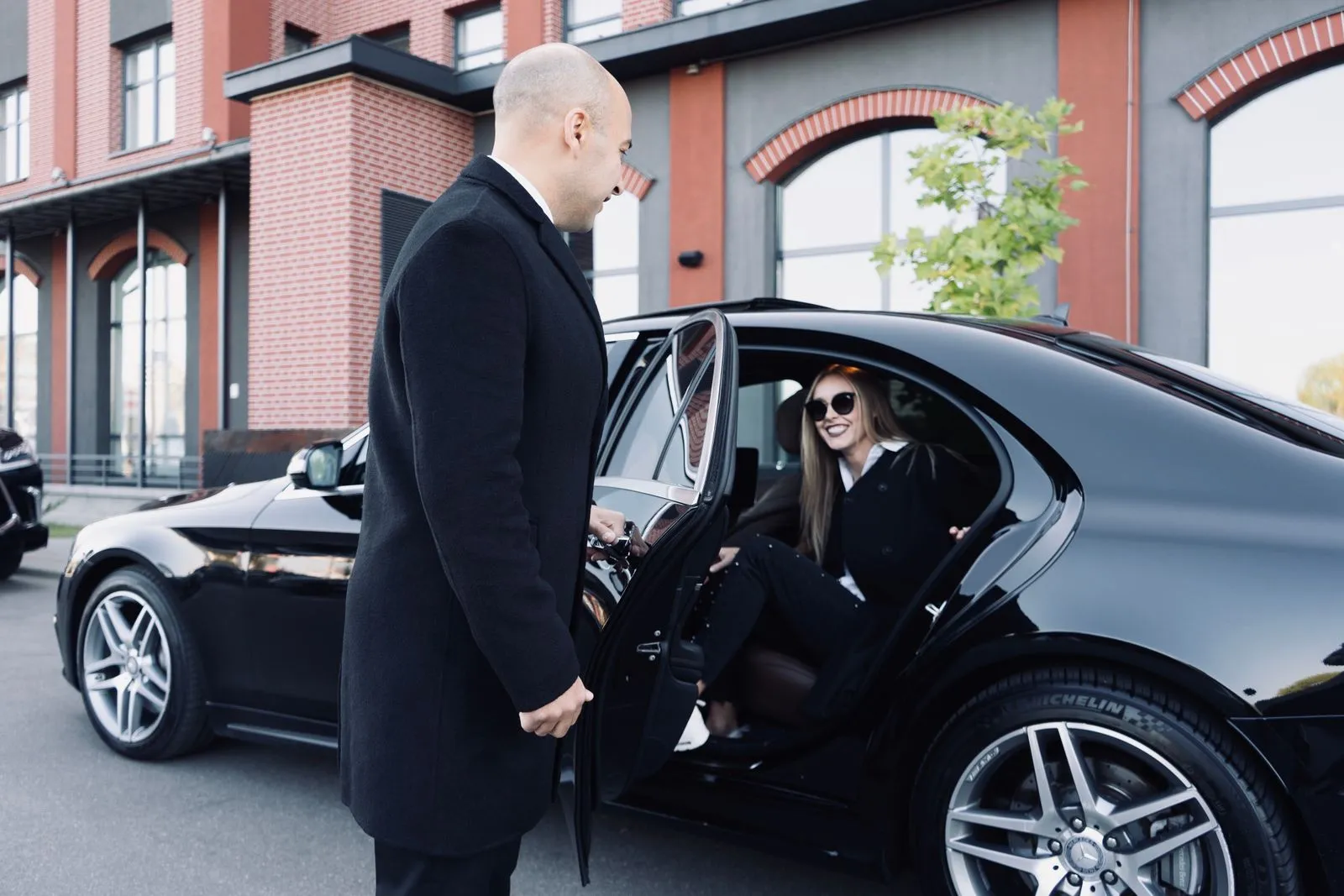
Every chauffeur assigned to a wedding wears formal attire as standard, and a tuxedo upgrade is available on request for couples who want the driver's presentation to match a black-tie affair specifically.
Rehearsal Dinners, Guest Shuttles and the Day After
Wedding transportation rarely starts and ends with the ceremony day. Rehearsal dinners the night before, guest shuttle service between a hotel block and a venue with limited parking, and next-morning brunch transportation for out-of-town family are all commonly booked around the same wedding weekend, and coordinating them as one reservation set — rather than separate last-minute bookings — usually secures better vehicle availability on a busy wedding weekend.
Guest shuttles are particularly worth planning ahead for venues with restrictive parking, since a Sprinter van running a fixed loop between hotel and venue removes the need for guests to navigate an unfamiliar rural road themselves after dark.
Why Licensing and Insurance Matter More on a Wedding Day
A wedding books a vehicle for hours at a stretch, often across several venues and sometimes on rural roads a driver has never taken before — exactly the conditions where the gap between a personal auto policy and genuine commercial liability coverage becomes real rather than theoretical. A company operating under proper commercial carrier licensing carries insurance sized for exactly this kind of extended, multi-stop, professionally driven trip.
This is also why a dry run of the route matters more for a wedding than for almost any other kind of booking: a chauffeur who has already driven the actual approach to a rural vineyard or estate property, checked where to stage for pickup, and timed the drive between venues removes the single largest source of wedding-day transportation risk, which is a driver improvising a route for the first time while a wedding party is waiting.
None of this is unique to any one company — it is simply the standard worth insisting on, in writing, before a deposit changes hands, regardless of who you ultimately book.
Booking Your Wedding Transportation
Reserve as early as you reasonably can — six months out is common for peak spring and fall wedding dates, since Sprinter vans and stretch limousines are the first vehicles to book out on popular Saturdays across the region. Tell us your ceremony and reception venues, wedding party size, and rough timeline, and we will recommend the right vehicle mix and confirm a written flat hourly rate before any deposit is due.
Call (877) 609-1919 or book online — every wedding reservation includes a pre-wedding route review, a chauffeur in formal attire, and the same licensed, commercially insured standard we hold on every trip we run across DC, Maryland and Virginia.
Related Pages
Frequently Asked Questions
How far in advance should we book wedding transportation?
Six months ahead is typical for peak spring and fall Saturdays. Sprinter vans and stretch limousines book out first on popular dates, so earlier is always safer than later.
Is wedding transportation priced hourly or as a flat rate?
Hourly with a minimum, since a wedding day almost always needs the vehicle available across several stops rather than one point-to-point trip. The rate is confirmed in writing before you book.
What happens if our reception runs longer than planned?
Overtime is billed at the same confirmed hourly rate agreed to at booking — not a different, higher rate charged after the fact.
How many cars do we actually need for the wedding party?
It depends on your headcount and whether the ceremony and reception are at different venues. A couple typically needs one sedan; a wedding party of four to six needs an SUV; eight or more needs a Sprinter van. If the getting-ready location and ceremony run at the same time, you may need two vehicles working simultaneously.
Do you drive to rural or hard-to-find venues like vineyards and estate properties?
Yes — venues like Ladew Topiary Gardens, Loudoun County vineyards, and Frederick County estate properties are regular bookings, and every wedding reservation includes a route review beforehand so the chauffeur already knows the approach before your wedding day.
What is the cancellation policy for a wedding booking?
Free cancellation up to 12 hours before pickup for wedding and special-event vehicles (Sprinter vans, limousines and similar) — longer than the 3-hour window on a standard sedan or SUV transfer.
Can you provide guest shuttle service between our hotel block and the venue?
Yes. A Sprinter van running a fixed shuttle loop between a hotel and venue is one of our most common wedding-weekend bookings, especially for venues with limited on-site parking.
Are red carpet, "Just Married" signage and bottled water included?
These are standard touches on wedding bookings; confirm what is included in your specific quote when you book so there are no surprises on the day.
What should we ask before booking any wedding transportation company?
Confirm they hold commercial (not personal) insurance, ask whether your chauffeur is confirmed by name in advance, ask how overtime is billed, and get the vehicle, hours and total rate in writing before any deposit changes hands.
Do you handle rehearsal dinner and next-day brunch transportation too?
Yes — rehearsal dinners, guest shuttles, and next-morning transportation for out-of-town family are commonly booked as part of the same wedding weekend, and booking them together usually secures better vehicle availability.